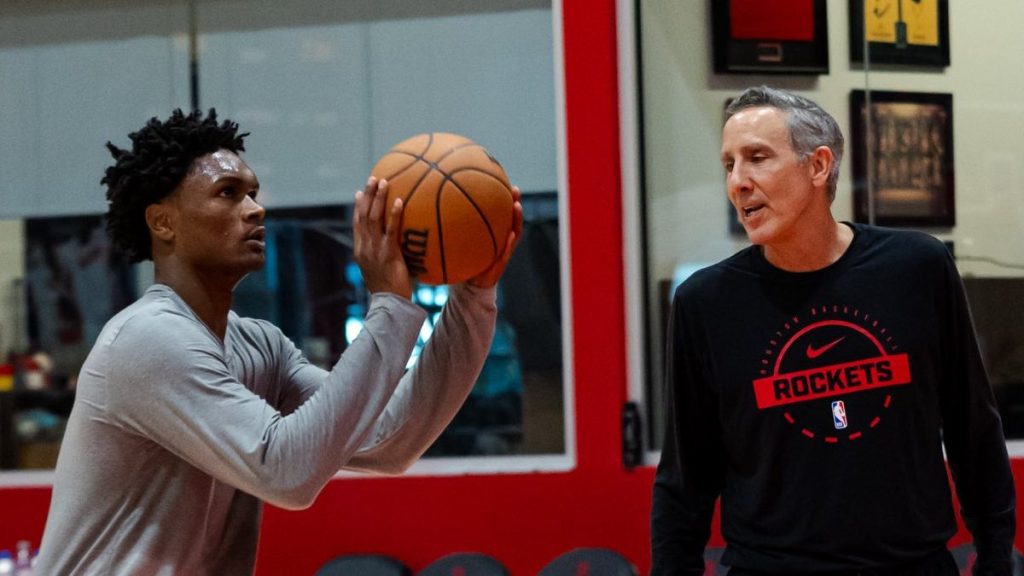
The era of the aprons, ushered in during 2023, has turned the old rules of roster building upside down. We are not only seeing changes in the contracts that get signed and the ones that don’t, but on this new board, youth has stopped being an excuse and become an opportunity.
Although it requires a generous dose of luck and a clinical eye for spotting raw quality, the most sustainable way to stack talent on one roster is to take advantage of the financial room afforded by rookie scale contracts. The current style of play on display in the NBA demands a level of physical intensity found mostly in engines that are, so to speak, still teenagers. And a depth of rosters that is achieved by paying many players below their market value. Whether through the aforementioned rookie contracts (the first three years of a career) or by signing a player just before he breaks out (Deni Avdija, Ajay Mitchell, Austin Reaves…).
Committed to internal development
This financial obligation to always count on young players as a core part of any roster, and not so much as complements, gives internal development a different meaning. That is, achieving greater output without adding players via trade or free agency. An unpredictable aspect from year to year, which franchises must now embrace more than ever.
Teams have limited influence over a player’s capacity to improve. Absorbing knowledge and a willingness to sacrifice are talents just as much as dribbling skill or a jump shot. Admittedly, they are far harder to measure. Nevertheless, the intermediaries who encourage that individual development are also the assets for which the organisation has no spending ceiling.
When Houston made the seven-way trade for Kevin Durant in the summer of 2025, it knew that over the next two or three years any improvement to the project would have to come at the margins. There is the extraordinary situation of Fred VanVleet’s injury and return, which gives a sense of improvement at no cost (beyond his extension signed in the same offseason Durant arrived). The other upgrade to the roster comes from signing Marcus Smart with the taxpayer mid-level exception. Enough to manoeuvre beneath the tax line and the aprons.
With that in mind, Rafael Stone understands that his main development focus is on Amen Thompson and Alperen Sengün. And, to unlock their full potential, he signs one of the great shooting gurus of the 21st-century NBA.
They say those who can, do; and those who can’t, teach. Chip Engelland, the Houston Rockets’ newly hired coaching staff addition, is widely known for his teaching of the art of shooting, with Kawhi Leonard and Tony Parker as the finest examples of his work during the 17 years he spent in San Antonio (2005-2022). But, long before he was teaching, the Shot Doctor was already doing.
The legend of Chip Engelland
Arthur, his real first name, was one of many players whose college career was not enough to attract the attention of the league of three letters. He spent his four NCAA years at a Duke that was nothing like the Duke of today, although Mike Krzyzewski was already in charge there. His main skill was shooting from outside, at a time when barely 2.4 threes per game were being attempted in the NBA. He himself was already taking 3.1 threes per game in 1982-83 (making 55.4%) from the modest 5.4 metres that marked the perimeter line in college basketball at the time.
In those Drafts that exceeded 200 selections and where, with luck, 20% played more than one season, Chip could not even make the 226 picked in the 1983 class. Basketball then pushed him across the Pacific to find a new home in the Philippines. He was not alone, but part of a small diaspora of college players brought there with the mission of strengthening the domestic competition and, above all, the national team. Launching the project in 1981, Engelland joined a side bolstered by American players whom Ron Jacobs, a respected coach who had arrived from Loyola Marymount University, recruited with the idea of naturalising them for the FIBA competitions at the end of the decade.
There Chip would live his happiest years as a player, blossoming in an unforgettable night in which he poured in 43 points against the United States national team to win the 1985 Williams Jones Cup. A tournament outside FIBA’s organisation, launched by the Chinese Taipei Basketball Association.
Three years that flew by were enough for Chip to cement his reputation as one of the finest shooters in the history of Philippine basketball. He did not even have time to receive citizenship before the definitive explosion of the People Power Revolution took Manila to overthrow the sitting regime.
Neither his connections with Philippine basketball nor the subsequent years bouncing between amateur teams in the defunct CBA (precursor to today’s G League) ended up building Engelland’s future. After so much back and forth, the Californian was going to have the strange honour of being a prophet in his own land.
Mentor to the best
Before Duke, before the Philippines and all the lower-tier basketball, Arthur was the weekly attraction in the affluent Los Angeles neighbourhood of Palisades during his high school days. From the stands of Pacific Palisades High School, a young Steve Kerr was preparing to inherit the stardom of a player with whom he shared a gift. At the table, keeping score of his baskets was the girl he was dating at the time, a scatterbrained Jeanie Buss who did not yet know she would be the heir to an empire.
With his days as a shooting craftsman over, it was now time to be a mentor. The Chip Shots academy opened its doors in the Chicago area in 1993 as a campus helping players of all ages improve their shooting. Engelland was soon absorbed by the world of mentoring as a speaker and consultant. And suddenly, the doors the NBA had closed on him a decade earlier swung wide open when Kerr came knocking again.
For a shooter, even a minimally negative change in his percentages can be a warning sign, however much they remain well above average. Kerr had arrived at the Bulls in 1993 after almost being left out of the league following a disastrous season. His minutes in Cleveland dropped off sharply, hurting his confidence and leading to his early trade to Orlando just after the 1992-93 season began. After averaging a phenomenal 47% in his first three years, he managed just 23.1% from three while attempting fewer than one shot per game across his spells in Ohio and Florida.
Terrified by how close he had come to the end of his NBA days, the guard arranged a dinner with Engelland. The former idol turned teacher convinced the still most accurate shooter in history that the foundations of his shot were solid, introducing only an almost imperceptible change to his mechanics that neatly sums up the attention to detail that made him a legend. “It was very subtle, but before working with Chip, the ball was leaving more from my middle finger than my index finger,” Kerr told Grantland (ESPN) in 2014. “He taught me to widen my hand outward enough to involve my index finger more.”
Engelland’s mantra with every young player in development, whether a Duke player or a professional who put himself in his hands, was always the same. Find a point at which they felt the shot as a comfort zone because it emerged as a natural extension of the rest of their game. His first masterpiece, like a great architectural project, was Grant Hill.
With the then Pistons guard, Chip Engelland did have to go back to the foundations. To the point of taking him to one of his campuses, surrounded by kids who barely reached the height of his waist, watching a four-time All-Star perform a shooting routine that they themselves had used as the basis of their own learning. “Being there with my hand behind my back at the Franklin Racquet Club with seven-year-old kids surrounding me, shooting one-handed shots from the three-point line next to the basket was embarrassing,” he told the Detroit Free Press in April 1999. “The worst part is that, the first few times, I couldn’t even make that shot. It was a process in which I completely broke my balance, my form and my mechanics. Sometimes you have to swallow your pride a little.”
Engelland and Hill began working together in September 1998, noticeably refining his shot selection and percentages from midrange and, as a consequence, raising his effective field goal percentage by almost 3 points (from 45.3 to 47.9%). At the end of the season, Detroit signed him as the Pistons’ official shooting consultant, further boosting the All-Star’s accuracy until his ankle began to fail him and he never again was the same.
He caught Shane Battier in time not to lose one of the first and most sophisticated 3&D prototypes this century has produced, centring the ball in his catch-and-shoot phase. He transferred the precision of Tony Parker’s pull-up jumpers to his jump shot so that he understood where the palm of his hand should be before release. He turned Kawhi Leonard’s behind-the-head shots into forward-momentum drills to transform him into a machine of productive offensive efficiency.
Most likely recommended by Ime Udoka, who was his protégé at the Spurs, Engelland faces a two-headed beast in the Houston Rockets. There has not been a single group training session that does not end with extra individual work for Alperen Sengün and Amen Thompson. The idea is not to turn them into two great shooters, but to have them feel the shot as a legitimate part of their game, helping them face certain situations with greater confidence and available options.
If the threat is enough to stop defences from sagging off him, Thompson’s physical gifts would be an even more unstoppable weapon than they are today. If being able to set up his shot with confidence from any context lets Sengün play more situations facing the basket rather than retreating to the post, we may one day see the player his qualities promise. Even a substantial improvement at the free-throw line would already be a step forward, especially for the Turkish big man (69% last season and below 70% for his career).
Engelland has kept his comments to himself about the work on the shooting forms of his new pupils. Jackson Gatlin, a journalist who follows the Rockets closely, points out that they only recently started working together and that patience will be key. We will probably have to wait some time to learn firsthand what nuances he has introduced into their shooting mechanics. For now, we can only scrutinise clues in the training videos and the few preseason games they have played:
The sample is tiny, with Sengün going 0/4 from three over two games and Amen 1/5 over three games. Whether there is any improvement will only become visible as games accumulate, and with Thompson in particular it would not be realistic to expect average shooter percentages when he has barely topped 20% over three seasons. In principle, the idea should be to align Sengün’s elbow and have his legs reach shoulder width by the time the shot is loaded. With Amen, the goal is to make his mechanics a consistently continuous motion and reduce his tendency to pull up off the dribble with his legs spread.
Turning to Chip Engelland to achieve that marginal improvement, which the salary cap space does not allow for, says more about the needs of the Houston Rockets than about Chip Engelland himself. Hundreds of players have passed through his hands, yet we know of no more than a dozen successful cases, each with its own particular context. Employed since 2022 by the Oklahoma City Thunder, the Shot Doctor failed to make Josh Giddey’s shooting sustainable in the playoffs. He did not make Chet Holmgren’s confidence dips from the field disappear. Lu Dort has dropped from 39% to 30% from three in barely two postseasons. Miracles to Lourdes.
What his arrival at the Texan franchise does indicate is the Rockets going all-in on this group of players, at least for the seasons ahead. And if it is not with Engelland, we will have to conclude that shooting will never be an intrinsic part of Thompson’s and Sengün’s games.
(Cover photo of Houston Rockets/X)