“With one touch you’re the best in the world. With two touches, you’re very good. With three, you’re just average”
Pep Guardiola to Sergio Busquets
For years now, aesthetics have embraced minimalist principles. Homes are dominated by space rather than objects, stripped of any textured Artex, terrazzo flooring or those display units built to house a cathode-ray telly. Logos are round and sparing in detail so they stay legible in digital settings. T-shirts are plain and monochrome so they go with everything.
In a society obsessed with production and efficiency, we are often told that less is more. And sometimes it is. But, as with everything, completely discarding a way of looking at the world tends to be harmful.
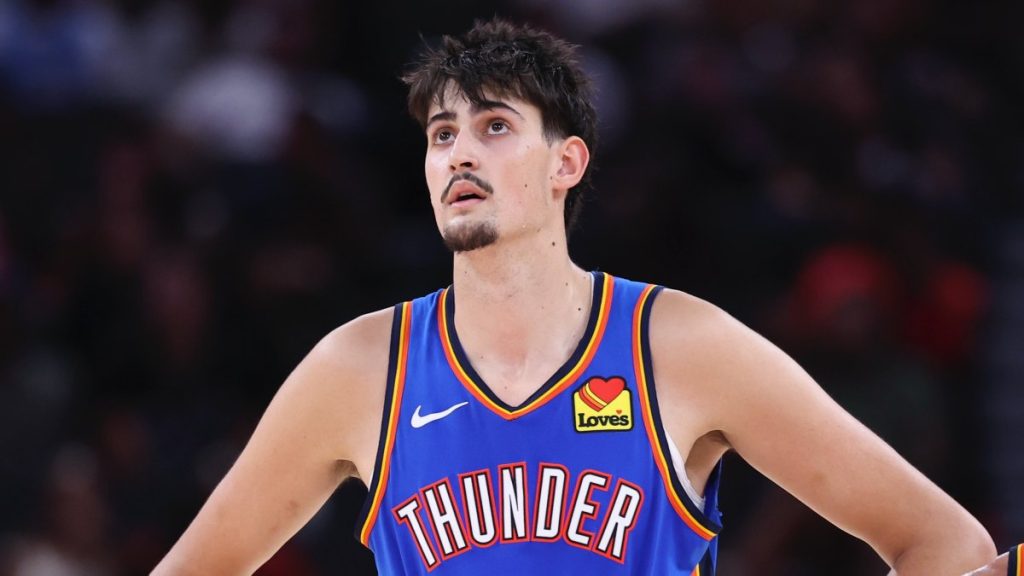
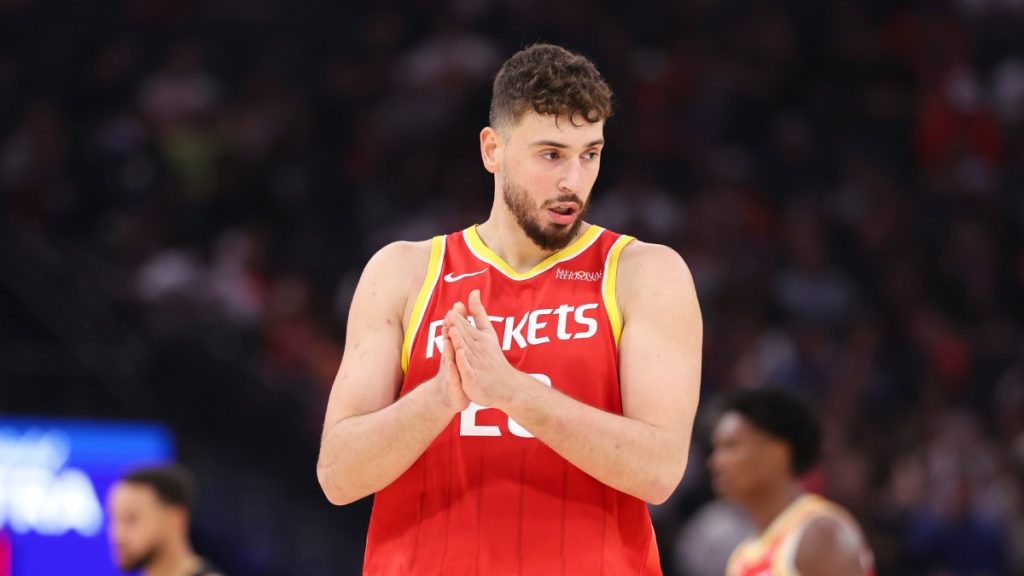
Alperen Sengün has always been a maximalist. His game has been ornate, as you would expect given the culture he comes from. From a very young age, the Turkish big man felt clearly superior technically to other players his size. Especially off the dribble and with his passing, which he used to put the ball on the floor and embellish every opportunity he got.
Those same qualities made him stand out to the eye the moment he stepped onto an NBA court. The hope was that time would smooth off the excesses and sharpen his game. Always, and somewhat unfairly, with Nikola Jokic as the mirror.
If that tiresome comparison was unfair, it is because, while the Serbian lightens the game until it vaporises, the Turk’s basketball carried too much lead. Sengün did not approach the game with the same verbs as Nikola. Where one sought to impose, the other sought to flow. And until that changed, the Rockets man was not going to be able to sharpen all his technical finesse and elevated feel for the game.
For one reason or another, between the context around him and the competitive demands, both his own and others’, Sengün had not been able to shear his game down. He used his supposed technical load to barrel (usually with his back to the basket) into typically well-set defences. The result was being one of the least efficient bigs in the entire league as a shooter and a better-than-average creator for his position, but not enough to carry the creative burden of a contender. Come the playoffs and without Durant, his game and that of the Houston Rockets collapsed.
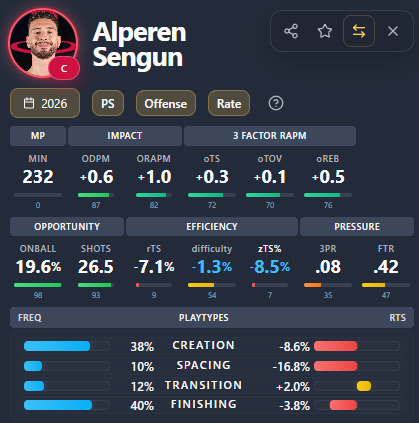
The poor showing in April probably spurred a transformation that the return of Fred VanVleet and a collective mindset of rediscovering the joy in attack have made possible.
Nuances of the new Rockets
The Houston Rockets remain one of the slowest teams in the whole league at building their attacks. On average, they use up 15.4 seconds of the shot clock on each possession. That is the second-highest figure of the 30 teams, identical to last season. Even so, watching them play, there is a sense of a certain liberation compared with the basketball they were playing under Udoka. And to find that difference statistically, you have to look at the number and type of passes the team makes.
The Rockets are making 14 more passes per game than last season and are the eighth team that uses hand-off passes the most, having been in the bottom third of the table last season. It should be stressed that NBAStats.com only records the hand-offs that end in a shot, but it is obvious that these Rockets put far more emphasis on this type of sequence to energise the half-court attack. That has translated into three more assists per night.
As luck would have it, those are precisely the areas where Alperen Sengün has changed his approach to attacking. The Turk is having his best season in terms of assists, and it is not because he has refined his passing execution or become more creative, whatever that may mean. Rather, it is because the scheme has put him at the centre of creation on the condition that he simplifies his game and speeds up his decision-making. In this way, he may not be the most decisive or the most differential player on these Rockets, but he is their system player.
In short, the Turk’s touches on the ball have increased, he is passing more than ever, but the time he spends with the ball in his hands has dropped. In other words, he does more in quicker actions.
There are three points of emphasis in this change:
1. Speed in resets. Too often Sengün would receive in the intermediate zones and try to force the action before realising he was heading down a blind alley and then, only then, resetting the action having lost the advantage. This year, you can clearly see how, after receiving, he needs only a tenth of a second to recognise whether he can be aggressive and, if not, take a dribble towards his nearest teammate on the perimeter to run the hand-off and keep the advantage alive. This keeps the defence in pursuit and also makes it easier for him to continue to the rim, where he is more dominant than ever, producing 1.28 points per action as a roller.
2. Breaking after a post fake. Again, Sengün’s problem is not his technical limitation. In the case of post-ups, that means his footwork and hips. It is more the fact of attacking in unfavourable situations, with the defender well set, help nearby, and relying too heavily on brute force to hammer the paint. This season, however, you can see how he receives in clean situations (he has cut his volume by five post possessions per game) and needs just one fake to attack aggressively.
3. The emphasis on drives. Nine hundred and four words in and I still haven’t mentioned the obvious: Sengün is hitting his threes. Right now he is converting a probably unsustainable 51.4% on a little over two attempts a night. That, striking as it is, is not what really matters. What is relevant is how the Turk is making use of it.
Linked to the previous point, Sengün takes advantage of his shot now being a threat to be far more vertical after faking the shot. He finds a much clearer interior thanks to the attention he draws himself, but also thanks to the dynamism and spacing principles the Rockets are working so well in this first stretch of the season (their actions with VanVleet as screener are devastating). He is the big man in the league who generates the most points from his drives.
Not much more, just better
Numerically, the raw improvement is nothing out of this world. It is 1.6 more points, 1 more assist and 0.4 more rebounds, plus 0.4 fewer turnovers. The jump in scoring can almost be explained by one extra free throw per game at the best percentages of his career. For the umpteenth time, it is not a matter of individual volume, but of the improved health of the Rockets’ offensive system.
The current version of Sengün is very similar to the ideal imagined with him as a creator. And largely because of that, Houston have the best attack in the league right now, generating 121.3 points per hundred possessions. Though it isn’t all rosy.
Broadly speaking, the Rockets are better with Sengün on the floor. According to Cleaning The Glass data, the team is 7.2 points better on offence per hundred possessions with him on court than in the minutes he spends on the bench. That figure sits in the 83rd percentile of the whole NBA and is the highest on the Texan side. The clutch is a different matter.
The final barrier
If there is one outstanding task for these Rockets, it is closing out tight games. Last season they were already a team that struggled in clutch situations, posting a 22-23 record in the regular season and 1-2 in the playoffs when games were decided by narrow margins.
So far this season, they have played nine games under those conditions (separated by five points or fewer at some point in the last five minutes) and their record is 5-4… but with a negative point differential. They have beaten teams such as San Antonio, Atlanta, Denver, Golden State (the day Curry got injured) and Utah. They have lost to Dallas, Phoenix, Denver and Minnesota. And, above all, they have been very inconsistent defensively.
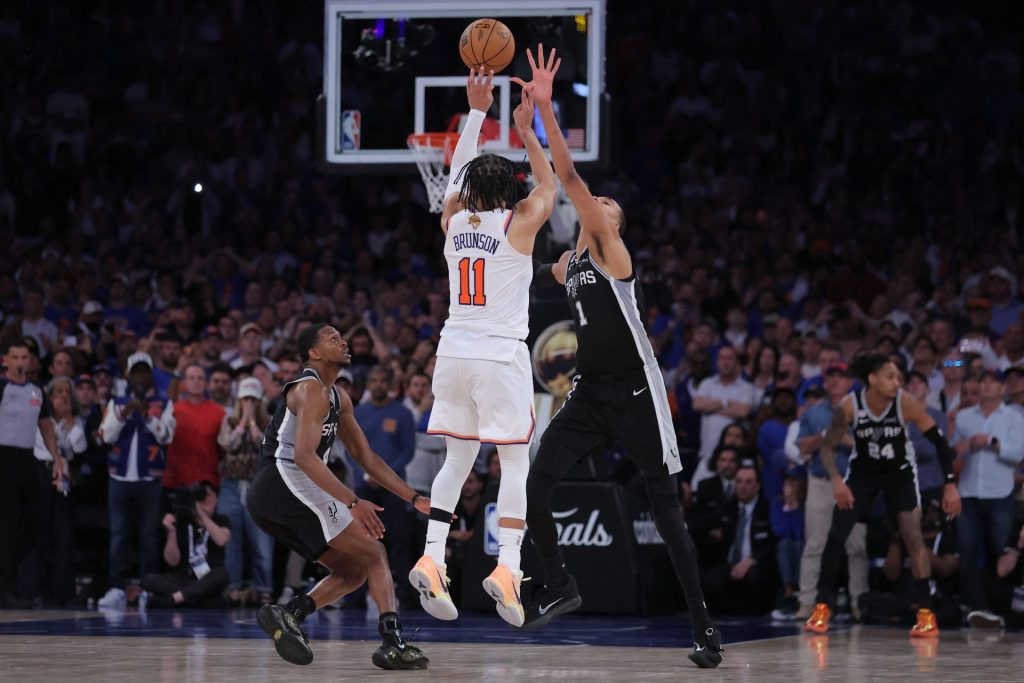
It should be said up front that there is no team whose behaviour doesn’t change as a game nears its conclusion. The Knicks, who built their championship team around collectivism and the flow of ball and bodies in attack, entrust themselves to the heroics of Jalen Brunson to seal the title. The Spurs, dominant through vertigo-inducing pace and physical imposition, run less and make more mistakes.
That said, Houston still seem far from finding a formula to address these shortcomings. The reflection of Udoka’s doubts can be found in the game lost to the Denver Nuggets on 20 November, where the Rockets staked the game on operating from the pick-and-roll between VanVleet and Sengün, isolating the rest of the team. Until now, Houston seemed to depend too much on Kevin Durant’s shot-making; in the last three games decided in the clutch, his usage has dropped from 39.3% to 20%.
Precisely, if the new Sengün is helping the team, it is because his movement across the whole front of the attack pushes the others into areas and situations more favourable to raising the quality of their shots. Reducing his contribution to isolation or the central pick-and-roll will not work against good defences. Fortunately, Udoka and the Rockets have plenty of examples that healthier offensive basketball is possible.
Perhaps Houston and Sengün can be blamed for the step back the team has taken on defence. Especially in the well-worn clutch. But that is Udoka’s and the group’s area of expertise, one that should be safe once it can be trusted blindly again. For now, the focus is rightly where it is, since this project ran the risk of stagnating if it did not glimpse progress on the side of the court where its ghosts reside. And Alperen Sengün is the Dr Peter Venkman of this hunt.
(Cover photo by Troy Taormina-Imagn Images)